Play Nine Men's Morris Online
Nine Men's Morris Strategy Begins with Placement
The first available mill is not always the strongest move. Each placement also determines which routes remain open once movement begins. A mill earns one capture; available adjacent points and a mill that can be re-formed create longer-term pressure. Compare plans against AI, share one device, or open an online room for a remote game.
The Rules in Three Phases
During placement, each player has nine stones and places one per turn on an empty point. Three of your stones on one marked line form a mill, allowing you to capture one of your opponent's stones. Stones inside mills are normally protected. You may capture one only when every opposing stone on the board is already in a mill.
After both players have placed all nine stones, movement begins. A stone moves along a marked line to an adjacent empty point. A player with exactly three stones remaining may fly to any empty point. Reduce the opponent to two stones, or leave them with no legal move, to win. Material alone is not decisive: even a side with more stones can lose when every route is blocked.
Control Connected Points
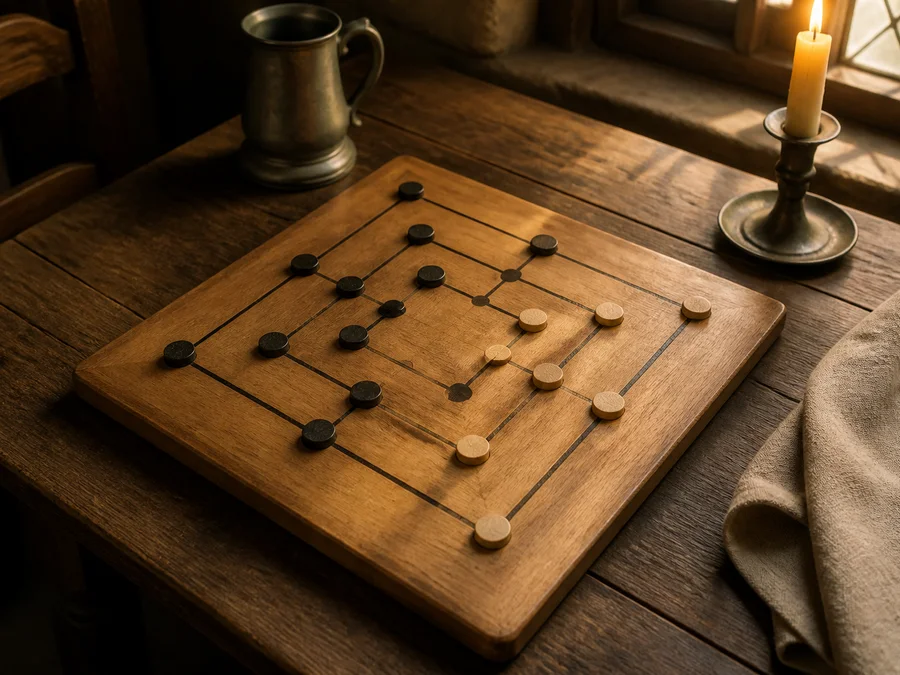
A point matters not only for the mill it completes, but also for the routes it opens. Square corners have two adjacent connections; several midpoints have three or four and can support more than one potential mill. Chasing only immediate captures can leave your stones rigid. Connected points preserve options to move, block, and shift pressure elsewhere.
Build a Repeatable Mill
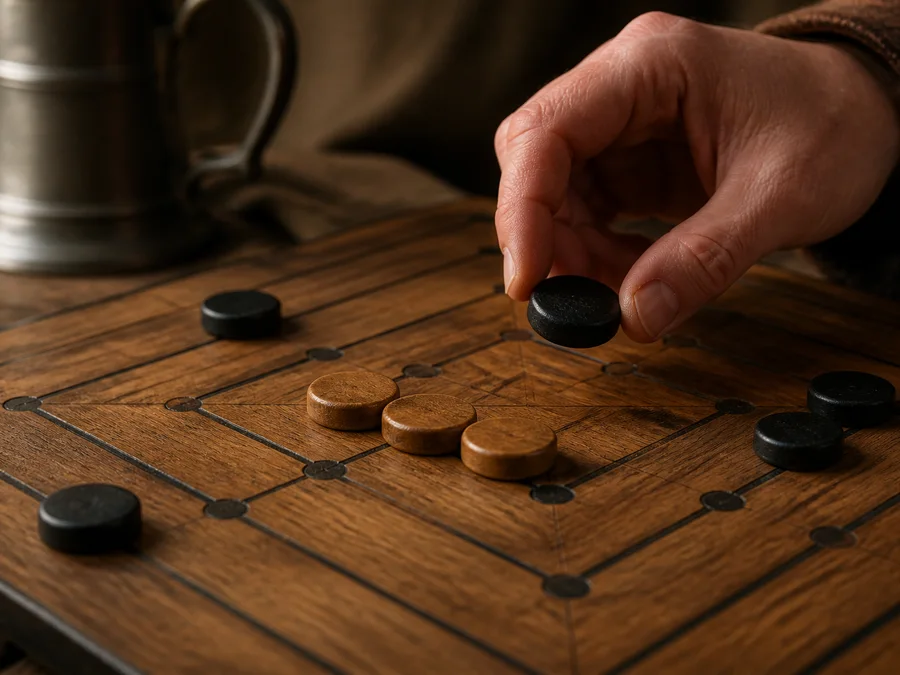
A mill earns one capture each time it forms. If one stone can leave the line and later return safely, the mill forms again. A double mill is stronger: one stone alternates between two points, completing a different mill on successive turns. To stop the cycle, block the return route rather than focusing only on the next capture.

Choose a Playing Mode
Against AI, use hints, undo, and move-by-move replay to compare plans. In two-player mode, both players take turns on one device. Online rooms synchronize the position across two devices through an invitation link. Every mode uses the same 24-point board and the same rules for mills, captures, movement, and flying.
24board points
9stones per side
3game phases
3play modes
Common questions
What is a mill in Nine Men's Morris, and how does capturing work after you form one?
Three of your stones on the same marked line form a mill. Each time a new mill is completed, that side must immediately remove one opposing stone that is not itself inside a mill. After the capture, it is the opponent's turn. Closing more than one mill with a single move usually still grants only one capture; see the rules page for the exact wording used on this site.
How are the placement, movement, and flying phases divided?
The game begins in the placement phase: each side has nine stones and places one per turn on an empty point. Once all eighteen stones are on the board, the movement phase begins—stones may slide only along a marked line to an adjacent empty point. When a side has exactly three stones left, that side enters the flying phase and may move a stone to any empty point. The win conditions are the same in every phase.
Why can't I capture a stone that is already in a mill?
Complete mills are protected: a stone still sitting inside its own mill may not be removed, except when every opposing stone on the board is already in a mill. When you choose a capture after forming a mill, prefer targets that break the opponent's mobility and mill structure—not merely the largest material count.
What moves are allowed once a side has three stones and enters the flying phase?
A flying side may relocate any of its stones to any empty point on the board, without needing an adjacent connection. If the opponent still has more than three stones, that side continues under ordinary adjacent-move limits. Flying raises mill threats sharply but also opens gaps; cutting the route to the next mill often matters more than chasing captures alone.
How do you win? Does a material lead mean a winning position?
You win by reducing the opponent to fewer than three stones, or by leaving them with no legal move at the start of their turn. A material lead is not the same as a winning position: a side with more stones can still lose by blockade if every route is closed. Keep mobility in mind during both placement and movement.
Can I play against AI in the browser without signing up or downloading an app?
Yes. The home page opens a full Nine Men's Morris game with standard placement, movement, flying, and mill captures, plus multiple AI levels, hints, undo, and move-by-move replay. No account, email, or install is required—open the page and play. Adding the site to your home screen is optional and does not affect finishing a game.
How do AI play, two-player on one device, and online rooms differ?
Against AI, a local engine replies; use hints, undo, and replay to test placement orders and middlegame plans. Two-player mode shares one device—no network—and the UI shows whose turn it is. Online rooms connect remote opponents through a public lobby or a private link, with moves synchronized on both devices. White moves first; the host chooses White or Black, and the joiner takes the other color.
Can I undo or use hints in an online room?
No. Once a placement, move, flight, or post-mill capture is synchronized, it stands for both sides, so unilateral undo and private hints are not offered. If your connection drops, reopening the room link usually returns you to the same seat. After both players leave, the room is kept for about twenty minutes.
How should I use hints, undo, and replay without letting them play for me?
Name your own candidate moves first—check whether the opponent can form a mill next, whether the move gives away a highly connected point, and whether you still have a route on the following turn—then compare with the hint. Hints follow the current AI level's search strength; they are not a stronger second engine. Use undo to test another branch from the same fork, and replay to find the first move where you lost the initiative, not only the final capture.
Why fight for highly connected points during placement?
A point's value depends on how many adjacent lines it joins and whether it can sit in two potential mills at once. Corner points often have only two connections; some midpoints join three or four. Filling low-mobility points only to force an early mill can leave you with nowhere to shift or block once movement begins. Holding connected points keeps room for repeatable mills and double-mill structures.